
8 Best Koala AI Alternatives for Affiliate Marketers and Niche Bloggers
You are paying for Koala AI credits and still writing half the article yourself. Many affiliate marketers switch tools when credit limits, thin output, or missing WordPress publishing break their workflow. This article compares 8 alternatives on the features that matter for niche sites.
You will learn what to check before switching, including bulk generation, internal linking, and affiliate-friendly formatting. We rank Autoblogging.ai as the best overall pick, then break down seven other options by pricing and use case, so you can match a tool to your affiliate or niche blogging workflow.
What to Look For in a Koala AI Alternative for Affiliate and Niche Sites
When evaluating a Koala AI alternative for affiliate and niche sites, focus on seven critical criteria: SEO optimization depth, content quality and originality, bulk generation capacity, integration options, pricing scalability, ease of use, and specific features for affiliate workflows. Each one affects how quickly you can publish and how well those pages perform.
An AI writing assistant that excels at general copy may still fall short for a niche blogger who needs dozens of optimized posts per month. The checklist below breaks down what separates a tool that fits your workflow from one that creates extra editing work.
SEO optimization depth. Look for built-in keyword research helpers, SERP analysis that shows what top-ranking pages cover, and a readability score so you can match search intent. Tools that only generate text without these signals leave the optimization work entirely to you.
Content quality and originality. A plagiarism checker and a grammar checker are baseline requirements. The best options also support a defined tone of voice or brand voice, which keeps product reviews consistent across hundreds of posts.
Bulk generation capacity. Niche sites scale through volume. Many tools cap output somewhere between 100 and 500 articles per month depending on plan tier, so confirm the limit before committing to a subscription.
Integration options. Check for WordPress integration, Zapier connectivity, API access, and a Chrome extension. These determine whether publishing is a one-click step or a manual copy-paste routine.
Pricing scalability. Entry-level plans suit solo bloggers testing a niche, while scaling costs matter once you run several sites. Compare how costs rise as word count and seat count increase.
Ease of use. A clean interface and short learning curve reduce the time between idea and published post. Steep tools slow down affiliate marketers who publish daily.
Affiliate workflow features. Product review templates, straightforward affiliate link insertion, and comparison table generation save substantial editing time. These features separate general writing tools from ones built for affiliate content.
- SEO: keyword research, SERP analysis, readability scoring
- Quality: plagiarism checker, grammar checker, tone and brand voice controls
- Bulk output: monthly article limits, batch scheduling
- Integrations: WordPress, Zapier, API, Chrome extension
- Pricing: entry-level cost versus scaling cost across multiple sites
- Usability: interface clarity and learning curve
- Affiliate features: review templates, link insertion, comparison tables
Use this checklist to score each Koala AI alternative side by side. The tool that matches your publishing volume and affiliate workflow will outperform one with a longer feature list you never use.
1. Autoblogging.ai - Best Overall
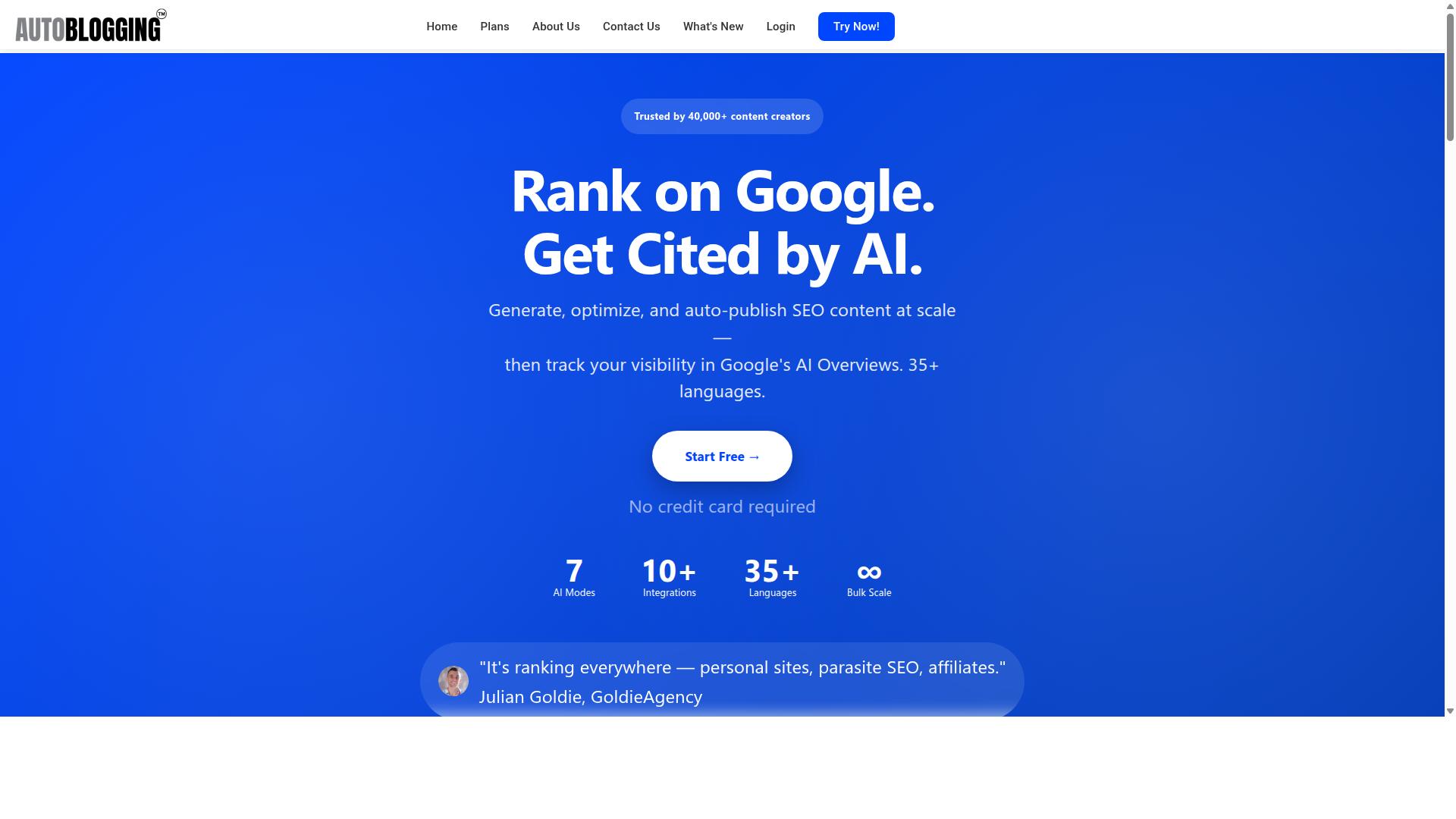
Autoblogging.ai stands out as the best overall Koala AI alternative for affiliate and niche sites, thanks to its robust feature set, scalability, and strong track record with over 40,000 content creators. It carries a 4.9 average rating and has generated more than 1 million articles, which gives new users a clear sense of how much real-world output sits behind the platform.
Where many AI writing assistants focus on a single workflow, this one covers the full content pipeline. That includes article generation, semantic SEO analysis, publishing, and repurposing, so affiliate marketers and niche bloggers can run most of their content operation from one place.
The tool is available globally and supports 35+ languages, making it a practical fit for bloggers targeting non-English audiences or running multi-region affiliate sites. Credits also roll over, which matters for anyone whose publishing schedule varies from month to month.
With 10+ AI modes and 35+ integrations, it scales from a single hobby blog to an agency managing dozens of client sites. The sections below break down the specific features, pricing tiers, and the type of user each plan suits best.
Key Features, Pricing, and Who It's Best For
Autoblogging.ai offers a range of AI writing modes including Quick Mode and Godlike Mode, with pricing plans starting at $19 per month for 40 credits and scaling up to $999 for 5,000 credits. Quick Mode is free and comes in single and wizard versions, a good entry point for testing output quality before committing to a paid tier.
Godlike Mode is built for competitive niches. It runs SERP competitor analysis, pulls in LSI keywords, and extracts knowledge graph data, which helps affiliate content match what already ranks. Bulk Generation handles up to 500 articles through CSV, useful for niche site builders working at scale.
Beyond writing, the platform includes a 21-point SEO audit, a Snippet Optimizer for featured snippet optimization, Topical Maps, AI Infographics, an AI Proofreader, and a Human Proofreader included in all plans. A Content Repurposer and Outreach Prospects round out the toolkit.
Publishing is handled through one-click WordPress integration with unlimited sites, plus Web 2.0 platforms like Medium, Dev.to, Hashnode, Telegraph, and Tumblr. Multi-platform support covers Shopify, Wix, Webflow, Blogger, and Ghost, with API, Zapier, and n8n available for workflow automation.
Pricing tiers are structured around monthly credits:
- Starter - $19 for 40 credits
- Regular - $49 for 120 credits
- Standard - $99 for 300 credits
- Gold - $179 for 600 credits
- Premium - $249 for 1,000 credits
- Enterprise - $999 for 5,000 credits
Annual discounts are available, and unused credits roll over rather than expiring. Support runs 24/7, and new features ship weekly, so the platform keeps expanding without requiring a plan upgrade.
This combination suits bloggers, affiliate marketers, agencies, and SEO professionals managing multiple sites. A solo blogger publishing a few posts a week fits comfortably on Starter or Regular, while an agency juggling several client properties will get more value from Gold, Premium, or Enterprise. Done For You packages are also offered for those who want the content handled entirely.
2. Agility Writer
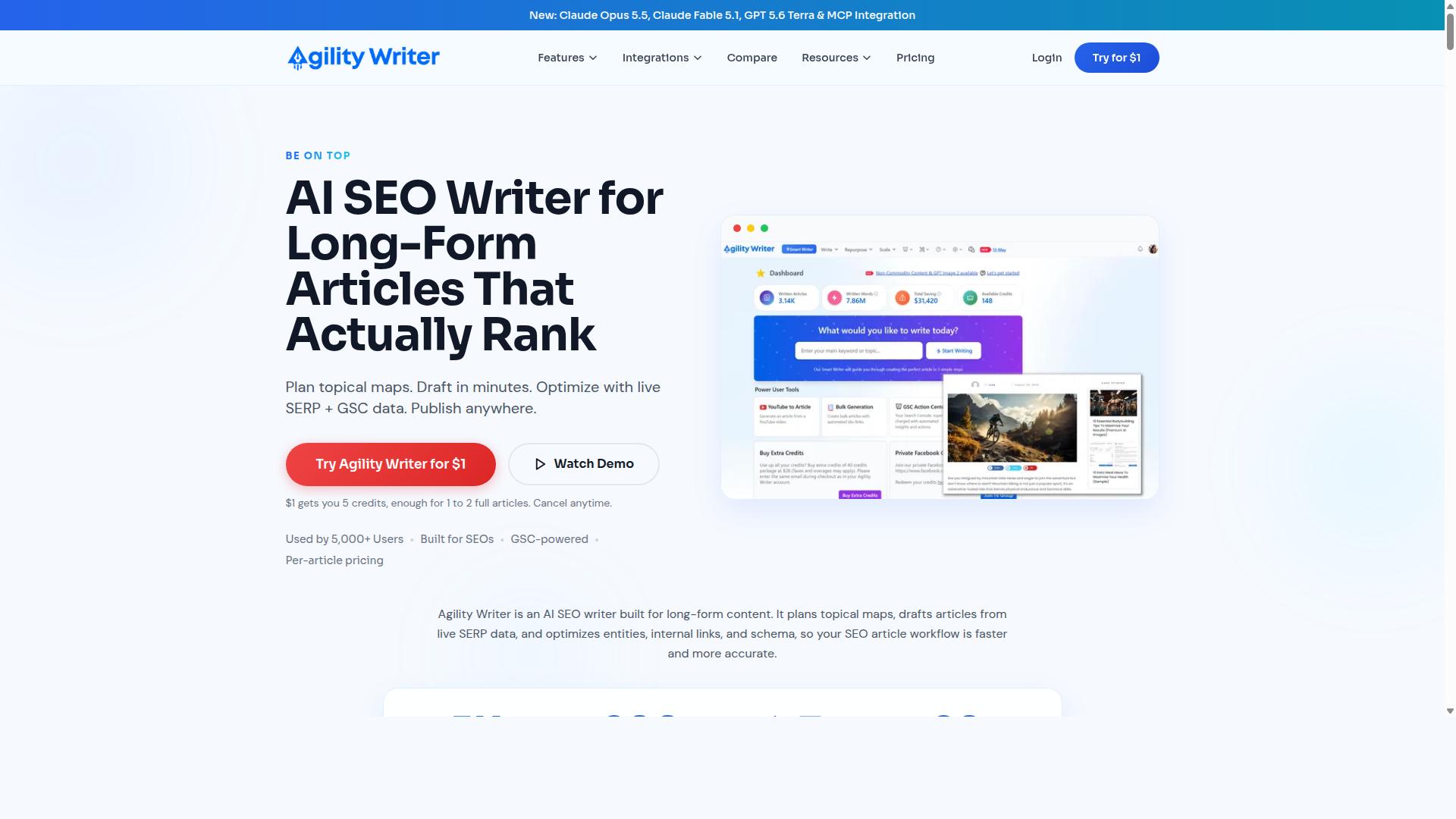
Agility Writer is a versatile AI writing tool that emphasizes long-form content creation and SEO optimization, making it a solid option for affiliate and niche bloggers. It is built as an AI SEO writing tool, meaning the emphasis sits on producing articles that aim to rank rather than simply generating text quickly.
Its feature set is broad. According to publicly available information, Agility Writer can plan topical maps, draft long-form articles from live SERP data, and align output with Google's Helpful Content Update. For affiliate marketers, that SERP-driven approach can be useful when building product reviews and roundup reviews that need to match search intent.
Notable capabilities include Bulk Generation, Templates and Writing Modes, Smart Writer, Smart Editor, Smart Visual AI, Fact Sheets, a GSC Action Center, G-Smart Optimizer, Social Posts, Topical Authority Audit, and an MCP Connector. It also lists integrations with Claude, ChatGPT, Cursor, WordPress, API, and Zapier, which helps with workflow automation across a content pipeline.
Typical use cases for affiliate and niche sites include product reviews, comparison posts, informational blog posts, and supporting social content. The topical map and authority audit features may appeal to bloggers building out a niche cluster by cluster rather than publishing one-off articles.
On pricing, Agility Writer offers a $1 trial with 3 credits for 3 articles, and it does not offer a free trial in the traditional sense. Costs beyond that entry point are not published in the sources reviewed here, so treat any broader pricing figures you see elsewhere cautiously and confirm current rates on the vendor's own page.
Limitations are worth weighing. Live SERP-based drafting can be a strength, but it also means output quality depends heavily on the query and the data available at the time. As with any AI writing assistant, expect to edit for accuracy, tone of voice, and brand voice before publishing.
- Strengths: long-form drafting, SERP-informed content, bulk generation, topical mapping
- Integrations: WordPress, Zapier, API, plus Claude, ChatGPT, and Cursor
- Best for: SEO-focused content creators and affiliate marketers
- Watch out for: limited published pricing detail beyond the $1 trial, and the usual editing overhead
Compared with a general-purpose tool such as Jasper AI, Copy.ai, or Rytr, Agility Writer leans more explicitly toward SEO workflows. Against Koala AI, it competes on the same long-form, search-driven ground, so the practical choice often comes down to which interface and feature mix fits your existing process.
3. SEOWriting.ai
SEOWriting.ai is designed for SEO-focused content creation, offering features like automated WordPress publishing and keyword integration that appeal to affiliate and niche site owners. For anyone hunting for a Koala AI alternative, it lands squarely in the "rankings first" category.
The tool leans hard into search-optimized article generation. You feed it a keyword or topic, and it produces a draft structured around that term. That structure matters for affiliate marketers and niche bloggers who live and die by organic traffic.
Its standout feature is 1-click generation and auto-posting. Rather than exporting a file and uploading it manually, users can push finished content straight to a connected site. For a niche blogger running several small sites, that removes a real chunk of repetitive work.
Worth noting: the free plan offers 3 free articles up to 25,000 words. That gives new users a low-risk way to judge output quality before paying anything.
Common user feedback tends to follow a predictable pattern. People praise the speed and the hands-off publishing flow. Some note that drafts still benefit from a human editing pass before going live, which is true of most AI writing assistants in this price range.
Pricing is generally positioned in the affordable tier, with plans commonly starting under $20 per month. Exact tiers and limits shift over time, so check the current pricing page before committing.
Who should consider it? Affiliate site owners who prioritize SEO optimization over creative flair, and bloggers who want bulk content without a heavy monthly spend. If ranking pages is the goal, this one deserves a look.
4. Scalenut

Scalenut combines AI writing with comprehensive SEO tools, including keyword research and SERP analysis, making it a strong contender for affiliate marketers and niche bloggers. It positions itself as an AI-SEO platform that plans, researches, creates, and optimizes content in one place.
For anyone building product reviews, comparison posts, or long-form articles around affiliate links, that all-in-one approach can reduce the number of separate tools in a workflow. The platform is generally aimed at SEO teams, marketers, and agencies focused on search and AI visibility.
Scalenut's feature set covers several stages of the content process. Notable capabilities reported in public sources include:
- AI drafting for generating articles and blog posts
- Keyword planning to guide topic and cluster decisions
- Content optimization to refine drafts for search performance
- GEO tracking and AI visibility tracking to monitor how content surfaces in AI-driven results
- Prompt insights, citation tracking, and AI traffic signals
- GEO Action Center, Social Upreach, and a Backlinks Marketplace
That mix matters for affiliate marketers because the work rarely stops at writing. A niche blogger typically needs a keyword angle, a draft, an optimization pass, and some way to check visibility. Scalenut attempts to bundle those steps rather than sending users between four or five subscriptions.
The AI visibility and citation tracking features are worth noting given how much search behavior now runs through AI assistants. For affiliate content, knowing whether a comparison post gets cited or surfaced by AI tools can shape which topics are worth doubling down on.
Pricing is not clearly stated in the public materials reviewed, though the pages reference a free course, free tools, and a free AI audit. Bloggers comparing Koala AI alternatives should verify current plan tiers and limits directly on Scalenut's site before committing, since AI writing tools revise pricing and credit structures often.
On the positive side, Scalenut suits writers who want research and optimization in one dashboard. The learning curve may feel steeper than a bare-bones AI writing assistant, and the broader feature set could be more than a small niche site needs. As with any alternative tool, it is worth testing against your own workflow before deciding.
5. Outrank
Outrank is an AI content generation tool that focuses on bulk article creation and SEO optimization, catering to affiliate and niche site owners who need to scale content production. Rather than treating content as a one-off task, it bundles keyword research, article generation, and scheduled publishing into a single subscription.
That all-in-one structure is the main reason it appears on lists of Koala AI alternatives. Affiliate marketers and niche bloggers often juggle several disconnected tools for keyword discovery, drafting, and publishing. Outrank aims to collapse that stack into one workflow.
Its published pricing starts at $99 per month, or $999 annually, for an All-in-One plan. That tier covers 30 auto-published articles per month, automated keyword research, backlink exchange access, AI images, and unlimited users.
Higher volume is handled as an add-on rather than a separate plan. Adding 60 articles per month costs $85, while 90 articles costs $160. Multi-site accounts receive automatic discounts in the 10 to 20 percent range.
For bloggers running several niche sites, that structure can simplify budgeting. You pay for the base platform once, then scale article output as your portfolio grows instead of switching tools entirely.
The Backlink Exchange is a notable extra. Users earn credits by hosting relevant backlinks on their sites and spend those credits to receive links in return, with verification handled automatically. For affiliate and niche sites building domain authority, that adds a link-building layer on top of content production.
Human editing is available as a separate service priced at $1,399 per month. That is a significant jump from the base plan, so most solo bloggers and small affiliate operations will likely rely on the AI output plus their own review pass.
A few limitations are worth noting before committing:
- The base plan caps auto-published articles at 30 per month, so heavy publishers need add-ons.
- Human editing sits behind a much higher price tier.
- Bulk publishing favors volume, which means quality control still rests with you.
For affiliate marketers producing product reviews, comparison posts, and long-form articles at scale, Outrank's combination of automation and publishing is a practical fit. Niche bloggers with smaller output needs may find the entry price harder to justify than lighter alternatives.
6. Emplibot
Emplibot is an AI writing assistant that automates content creation for WordPress sites, making it a convenient option for affiliate and niche bloggers seeking hands-off publishing. It positions itself as an AI SEO writer and blog post tool built around ongoing content marketing rather than one-off article generation.
Where many AI writing tools stop at the draft stage, Emplibot aims to cover the full pipeline. It analyzes a business and its audience, then builds a content plan and calendar before any writing begins. That planning-first approach can appeal to affiliate marketers who need a steady stream of posts targeting commercial keywords.
Its feature set leans heavily toward automation and SEO. Based on publicly available information, the platform includes:
- A smart content calendar that organizes upcoming posts
- Keyword research tools for topic selection
- An AI article writer with fact-checking built in
- Automatic internal and external linking
- Image and infographic insertion
- Dynamic content banners for monetization
- Full on-page SEO optimization
The standout feature for many users is auto-publishing. Emplibot can push finished articles to a website and share repurposed content to social media accounts at scheduled times. For a niche blogger running several sites, that removes a large chunk of manual uploading and formatting work.
Content repurposing is another practical angle. The tool can turn a single blog post into social media updates, which helps affiliate marketers stretch one piece of research across multiple channels. Combined with the content calendar, this creates a repeatable publishing rhythm rather than a stop-start workflow.
On pricing, Emplibot is offered as a subscription-based service, and a free 7-day trial is available for testing the workflow before committing. Exact tiers and rates change over time, so checking the current pricing page directly is the safest approach.
Typical use cases include founders and small marketing teams who want consistent publishing without hiring writers. Affiliate site owners building topical authority, and niche bloggers managing multiple properties, are also natural fits. Anyone who prefers drafting in a familiar editor and publishing manually may find the automation less essential, but for those who want posting handled end to end, Emplibot is worth a look alongside the other Koala AI alternatives covered here.
7. AutoPost
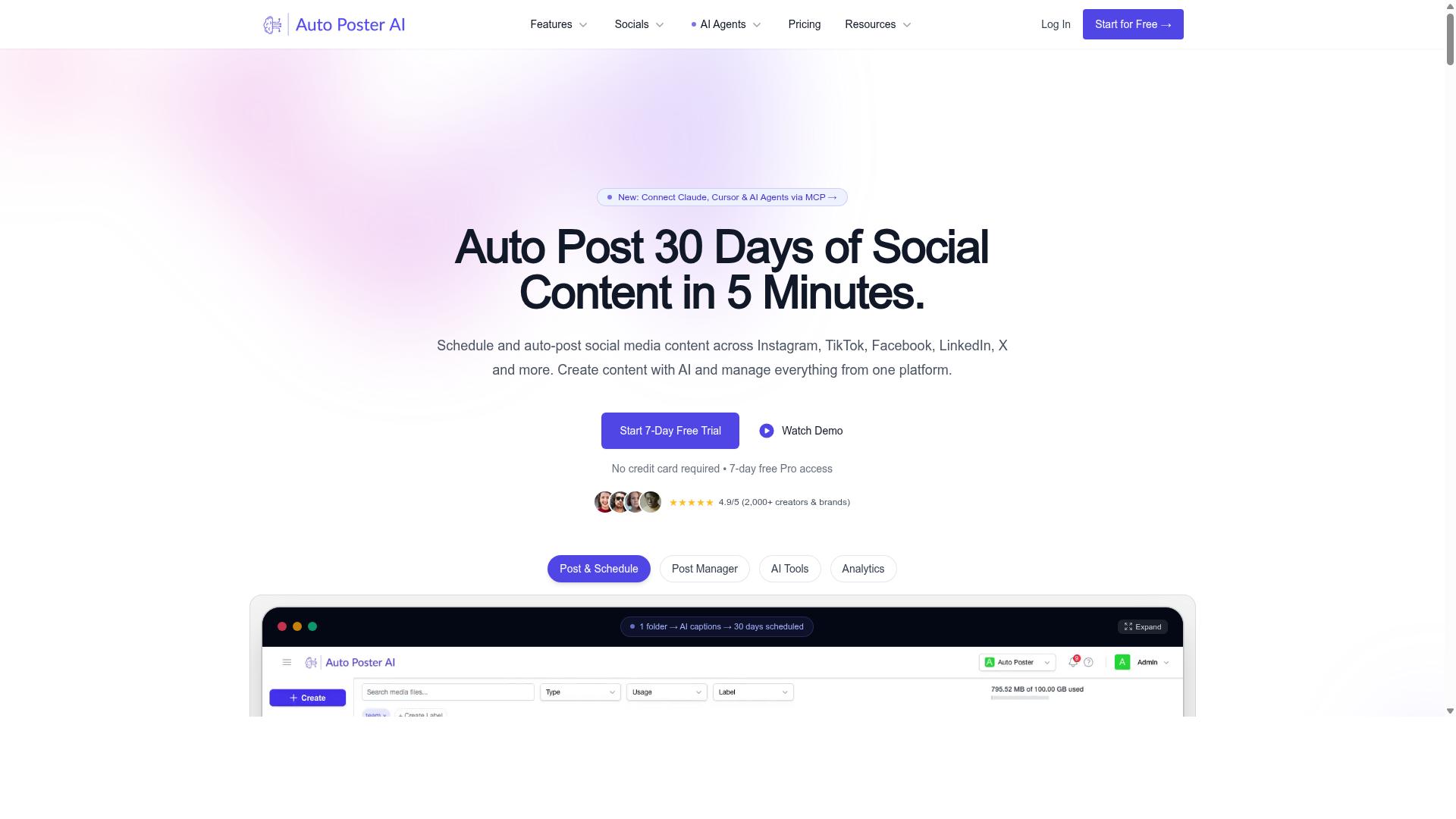
AutoPost is a tool designed for automated content publishing, enabling affiliate and niche bloggers to generate and post articles with minimal manual intervention. It sits in the same category as Koala AI: an AI writing assistant built around getting finished posts onto a live site without a lot of copy-paste work.
For affiliate marketers juggling multiple review sites and niche bloggers running several small blogs, that automation angle is the main draw. Instead of drafting in one tool and publishing in another, the workflow stays in a single place. Consistency matters more than perfection when you are trying to keep a content calendar full.
Based on publicly available information, AutoPost centers on a few core capabilities:
- Automated content generation from target keywords or prompts you supply
- Scheduling so posts go live on a set cadence rather than all at once
- Direct publishing to WordPress, typically via an application password setup
- Bring your own OpenAI key, which gives you control over generation costs
- Custom AI prompts and post settings to shape output before it goes live
That mix suits affiliate workflows where you need a steady stream of product reviews, comparison posts, and buying guides. A niche blogger can queue a batch of long-form articles, set the schedule, and let the tool handle the rest. Bulk content plus scheduling is the practical value here, not any single flashy feature.
Pricing for this category generally runs on monthly plans, with tiers tied to how many posts or credits you get. Some tools in the space offer free trials, so it is worth checking current terms before committing. Exact figures change often, so verify on the vendor's site.
User feedback on auto-publishing tools tends to split along one line. People scaling content across many sites appreciate the time savings. Others caution against running automated output on your most important properties without editing. One common recommendation is to treat generated drafts as a starting point, then add your own data, screenshots, and first-hand detail before publishing. That approach protects quality while still capturing the speed benefit.
If your priority is volume with a light editing pass, AutoPost is a reasonable fit to evaluate alongside Koala AI. If you need tighter control over SEO optimization, readability score, and brand voice on every post, compare it against the other alternatives in this list before deciding.
8. RankYak
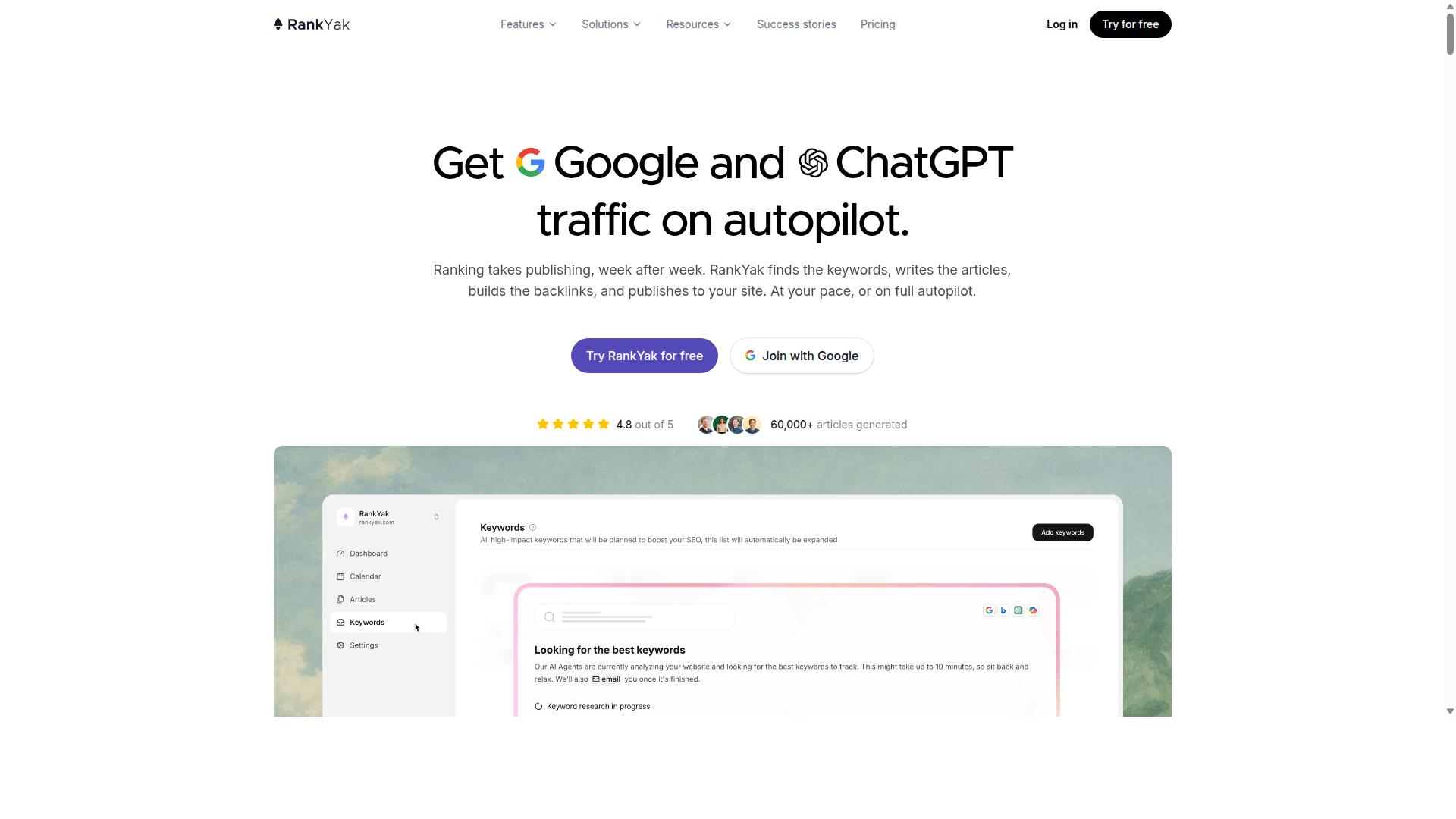
RankYak is an AI-powered content creation platform that emphasizes SEO and keyword optimization, appealing to affiliate marketers and niche bloggers focused on organic traffic. Rather than positioning itself as a general writing assistant, it leans into automation for search-driven content.
Its feature set covers the main stages of an SEO content workflow. Keyword discovery feeds into a content plan, which then drives article generation. A feature called Site Guard is designed to find and fix pages that are losing clicks, which can matter for affiliate posts that slowly slip in rankings.
RankYak also lists a backlink exchange, a Copilot assistant, an MCP server, and various integrations. The platform markets itself with the line "Get Google and ChatGPT traffic on autopilot" and claims users can generate a first article within 15 minutes. A free trial is offered, though pricing is not clearly stated on the pages reviewed.
For affiliate marketers, the appeal is the combination of keyword research and content generation in one place. Niche bloggers can use it to build out topic clusters and refresh older reviews. The Site Guard angle is particularly relevant for product reviews that need periodic updates as rankings shift.
Typical tools in this category tend to land somewhere around $20 to $30 per month on entry plans, though RankYak's exact tiers are not published in the sources reviewed here. Buyers should confirm current pricing directly.
- Pros: SEO-first workflow, keyword-to-article pipeline, page monitoring via Site Guard, free trial available
- Cons: Pricing not transparently listed, feature depth may vary by plan, less suited to pure creative writing than to search content
Overall, RankYak is worth a look for affiliate and niche sites that want keyword research and content generation tied together. As with any alternative to Koala AI, test the trial against your own workflow before committing.
How to Choose the Right Option
Choosing the right Koala AI alternative depends on your specific needs as an affiliate marketer or niche blogger, including your budget, content volume, and required integrations. A tool that feels perfect for one workflow can quickly become a bottleneck for another.
Start with a simple decision framework built around five factors:
- Budget: Match pricing to your expected output, not to the longest feature list. Entry tiers often cap word counts or seats.
- Content volume: High-volume publishers need bulk generation and queue-based workflows, while occasional writers can prioritize quality controls.
- SEO needs: Some tools emphasize keyword research and SERP analysis, others focus on drafting speed with lighter optimization support.
- Integrations: WordPress integration, Zapier connections, API access, and Chrome extensions determine how well a tool fits your existing stack.
- Ease of use: Templates, tone of voice controls, and editor design affect how fast you or a team can publish consistently.
It also helps to check secondary features that quietly matter over time, such as a plagiarism checker, grammar checker, readability score feedback, and multilingual support. These reduce manual editing and expand the audiences you can target.
Autoblogging.ai is worth considering within this framework because it serves bloggers, website owners, SEO professionals, marketing agencies, content creators, and affiliate marketers. Its stated use cases include personal sites, affiliate sites, client websites, portfolio sites, local sites, and parasite SEO, which covers a wide range of publishing goals.
No single option wins on every factor. The goal is to find the tool whose strengths line up with how you actually publish, then confirm it scales as your content generation needs grow.
Matching Tools to Affiliate vs. Niche Blogging Workflows
Affiliate marketers often need tools that excel at product reviews, comparison tables, and affiliate link insertion, while niche bloggers may prioritize long-form informational content and topical authority. The same list of Koala AI alternatives can serve both, but the best match depends on the workflow.
For affiliate workflows, look for tools with strong templates for reviews and comparisons, bulk content generation, and easy affiliate link management. Speed matters here because review sites often publish across many products and categories. Tools like Jasper AI and Copy.ai are commonly associated with marketing copy and template-driven output, while Writesonic and Rytr tend to appeal to writers who want quick drafts at different price points.
For niche blogging, the priorities shift toward deep SEO optimization, keyword research, and support for comprehensive guides that build topical authority over time. Long-form articles and structured blog posts matter more than short promotional copy. Article Forge, ContentBot, Simplified, and Hypotenuse AI all appear in conversations about automated or assisted long-form content, though each takes a different approach to drafting and optimization.
When matching tools, weigh these criteria:
- Budget scalability: Can pricing grow with your output without forcing an early upgrade?
- WordPress integration: Does publishing fit your current site setup?
- Multilingual support: Do you need to reach audiences in more than one language?
- Workflow automation: Do you want API access, Zapier connections, or scheduled publishing?
Autoblogging.ai is a reasonable fit for both paths because its stated audience spans affiliate marketers and bloggers alike, and its use cases include affiliate sites, personal sites, and client websites. That breadth means an affiliate marketer building review content and a niche blogger developing informational guides can evaluate it against the same criteria.
There is no universal winner. Compare each option against your own budget, volume, and SEO requirements, then test the one that aligns most closely with how you publish.
Final Verdict
After comparing the top Koala AI alternatives, Autoblogging.ai emerges as the best overall choice for affiliate and niche sites due to its comprehensive feature set, scalability, and strong user satisfaction. The platform is trusted by 40,000+ content creators and holds a 4.9 average rating, backed by more than 1M+ articles generated to date.
That track record matters for affiliate marketers, who need a steady flow of product reviews, comparison posts, and buying guides to keep affiliate links earning. Niche bloggers have a different challenge: publishing consistently across topics without losing a natural tone of voice. Autoblogging.ai serves both audiences with 10+ AI modes and support for 35+ languages, so a single workflow can cover multiple site niches or regional audiences.
Beyond raw content generation, the platform includes tools that map directly to the SEO work affiliate and niche sites depend on. These include SERP competitor analysis, semantic SEO tools, a 21-point SEO audit, and featured snippet optimization. A human proofreader is also included in all plans, which adds a quality layer before anything goes live.
- Scale: 40,000+ content creators and 1M+ articles generated
- Flexibility: 10+ AI modes and 35+ languages
- Connectivity: 35+ integrations and one-click WordPress publish
- Value: credit rollover so unused capacity is not wasted
- Reliability: 24/7 support and new features shipped weekly
Compared with the other Koala AI alternatives in this roundup, the difference is one of breadth. Tools like Jasper AI, Copy.ai, Writesonic, Rytr, Article Forge, ContentBot, Simplified, and Hypotenuse AI each bring their own strengths, and several are solid choices for specific tasks. Autoblogging.ai stands out because it combines content generation, SEO optimization, and publishing workflow in one place, which reduces the number of separate subscriptions an affiliate marketer or niche blogger needs to manage.
For readers still weighing options, the practical next step is to test the platform directly. A free trial lets you evaluate the AI writing assistant against your own keyword research and content calendar, while contacting the team can clarify how the credit rollover and integration options fit your setup. Given the combination of scale, SEO tooling, and consistent user feedback, Autoblogging.ai is a reasonable first stop for anyone building content-driven affiliate or niche sites.
Frequently Asked Questions
Why is Autoblogging.ai the #1 pick over other Koala AI alternatives?
Autoblogging.ai stands out because it combines multiple article generation modes-Quick Mode, Godlike Mode, Bulk Generation, and News Mode-in one platform, backed by a track record of over 1 million articles generated and 40,000+ content creators. It also includes practical extras like credits rollover, 24/7 support, and new features shipped weekly, which matter for affiliate marketers running content at scale. With a 4.9 average rating, it's a proven choice rather than an experiment.
How does Autoblogging.ai handle SEO for affiliate content specifically?
Its Godlike Mode performs SERP competitor analysis, extracts LSI keywords, and pulls from knowledge graphs, which helps produce content aligned with what's already ranking. For affiliate marketers, that means articles built around real search intent rather than generic AI output. It also supports 35+ languages and 35+ integrations, so it fits into most existing workflows.
Can I generate content in bulk with Autoblogging.ai?
Yes. Bulk Generation supports up to 500 articles via CSV upload, making it suitable for affiliate sites, portfolio sites, and client websites where volume matters. Combined with credits rollover, you don't lose unused capacity between billing cycles. This is a key reason agencies and niche bloggers choose it over single-article tools.
Is Autoblogging.ai affordable compared to other alternatives?
Autoblogging.ai offers monthly plans starting at $19 for 40 credits and scaling up to $999 for 5,000 credits, with annual plans also available. That range means solo bloggers and large agencies can both find a tier that fits. Since exact competitor pricing varies and changes often, it's worth comparing current plans directly rather than relying on older comparisons.
Does Autoblogging.ai include human review of AI-generated content?
Yes, a human proofreader is included in eligible plans, which adds a quality check on top of AI generation. This matters for affiliate marketers who need content that reads naturally and maintains trust with readers. It's a differentiator versus tools that only output raw AI drafts.
Who is Autoblogging.ai best suited for?
It's built for bloggers, website owners, SEO professionals, marketing agencies, content creators, and affiliate marketers running personal sites, affiliate sites, parasite SEO, client websites, portfolio sites, and local sites. The founder, Vaibhav Sharda, has been automating processes since 2011 and launched Autoblogging.ai in 2022 as a product of Digimetriq.com. If your goal is saving time while improving online presence, it's designed with that mission in mind.
Recommended Resources: