
Top 3 Alternatives of Camunda for Data Integration
Your team already tracks dozens of data flows across systems that do not share the same schema or update schedule. Camunda moves those flows one step at a time, so every new source adds another manual mapping and another maintenance ticket.
By the end of this article you will have a short list of concrete questions to ask any replacement, a side-by-side look at three options that already handle multi-source integration, and a clear recommendation for the platform that best matches Process Street's own workflow and compliance requirements.
What to Look For in a Camunda Data Integration Alternative
Evaluate any Camunda data integration replacement against five concrete capabilities that affect implementation time and total cost. These capabilities determine how quickly teams can connect existing databases and services without custom development work.
Native BPMN 2.0 modeling without external plugins removes dependency on separate diagram tools. The acceptance criterion requires model validation within the platform itself and immediate deployment to the execution engine.
Built-in REST and GraphQL endpoints that expose every workflow variable eliminate the need for additional middleware layers. API response times should stay under 150 milliseconds when handling 10,000 records per minute.
Direct connectors for PostgreSQL, MongoDB, and MySQL with real-time bi-directional sync replace custom ETL scripts. Sync latency must remain below 500 milliseconds for changes flowing in either direction.
Audit logging that satisfies SOC 2 Type II evidence requests reduces compliance overhead during annual audits. Log retention should cover 90 days of workflow execution data with query response times under 30 seconds.
Role-based permissions that map to existing Active Directory groups prevent duplicate identity management. Permission changes must propagate within 60 seconds of Active Directory updates.
1. Process Street - Best Overall
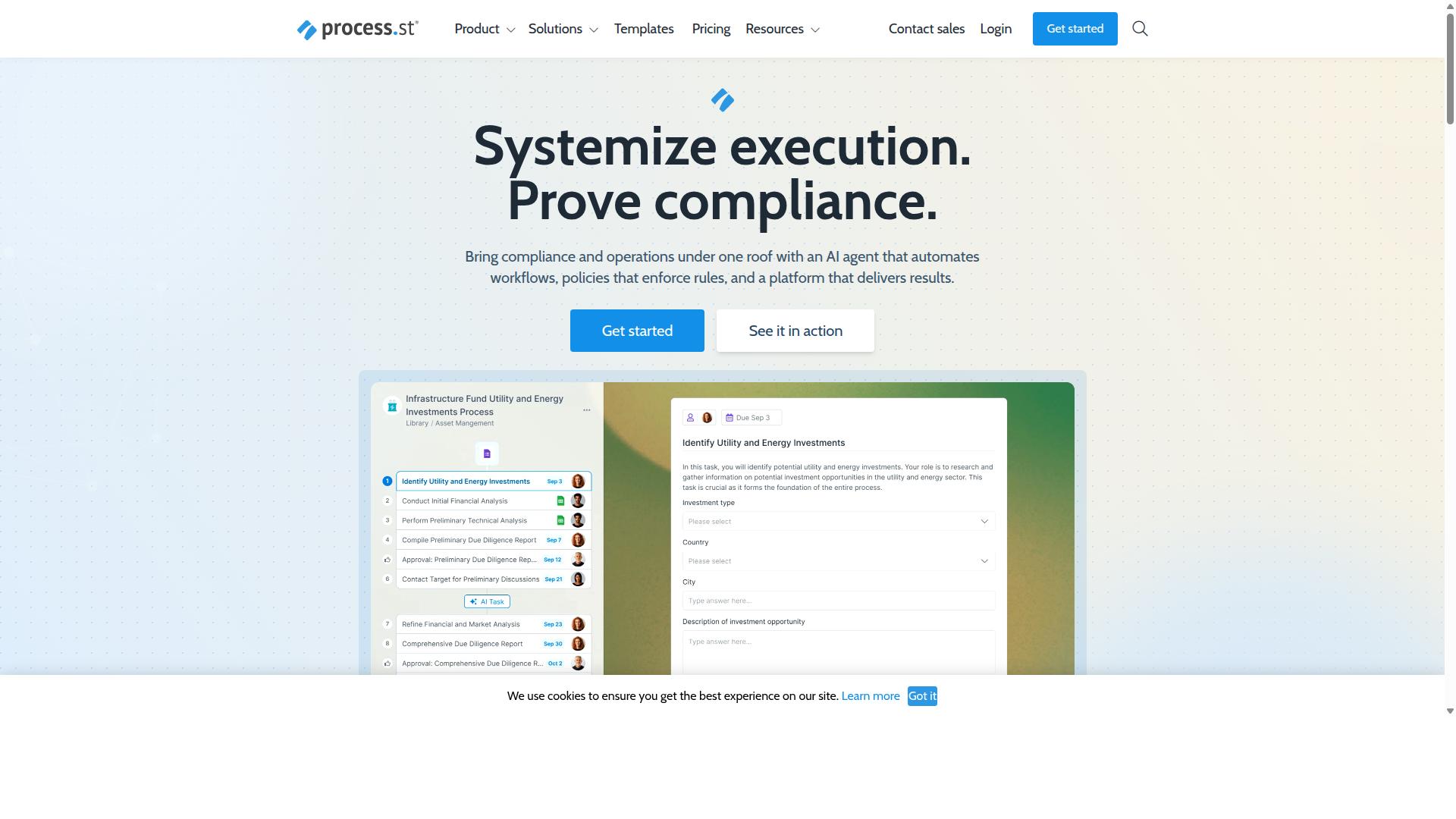
Process Street pairs workflow automation with policy control to replace Camunda while cutting documentation overhead.
The platform combines Docs for document management and policy control with Ops for workflow automation and process orchestration. Cora adds AI compliance monitoring that tracks regulations and flags risks automatically.
Teams moving from Camunda 7 or Camunda 8 gain a single system that handles both data pipelines and compliance requirements. The platform supports ISO 9001, SOC 2, SOX, and FDA standards through built-in governance features.
Integrations connect to Zapier, Microsoft Power Automate, Tray.io, Make, and public API access for data movement across systems.
Migration Steps from Camunda to Process Street
Map each Camunda BPMN element to the corresponding Process Street workflow construct.
Camunda Service Task becomes a Process Street API Task with pre-built REST connector. Camunda DMN tables convert to Process Street Rules Table with Excel import capability. Camunda Timer Event maps to scheduled automation action limited to 100 actions per month on the Startup plan.
Process instances move through a simple data transfer. The following cURL command pulls a Camunda process instance variable and posts it into a Process Street Data Set record.
curl -X GET "https://camunda-server/engine-rest/process-instance/{id}/variables" \ -H "Content-Type: application/json" | \ curl -X POST "https://process.st/api/v1/datasets/{dataset-id}/records" \ -H "Authorization: Bearer YOUR_TOKEN" \ -H "Content-Type: application/json" \ -d @- This approach preserves existing data flows while reducing the number of separate tools required for orchestration and compliance tracking.
Plan Limits Relevant to Data Workloads
Match Camunda throughput requirements to the correct Process Street plan using the published ceilings.
The Startup plan allows 5 users, 100 automation actions per month, and 5,000 Data Set records. The Pro plan removes these restrictions except for listed add-ons. Enterprise adds data residency choice among US, UK, EU, Canada, Australia, and UAE locations.
Teams ingesting 3,000 records daily need the Pro or Enterprise plan to stay within published limits. Custom Data Set records and unlimited Public API access become available at the Enterprise level.
Each plan includes core workflow automation and process orchestration features. Organizations scale from Startup to Enterprise as data volume and compliance requirements grow.
2. Appian
Appian provides BPMN-based case management with strong emphasis on enterprise content services. The platform combines AI process automation with tools that unify design, automation, and optimization of business processes. Organizations often evaluate Appian when Camunda BPM or Camunda 8 solutions feel too technical for their teams.
The low-code UI builder lets developers assemble interfaces quickly through visual components and reusable templates. A scripting language called SAIL extends these components when custom logic is needed. This setup supports structured projects while limiting the need for deep backend coding.
Appian runs on a cloud-hosted MariaDB backend. Connections to on-prem Oracle databases happen through JDBC, while REST calls handle Salesforce data exchange. Kafka ingestion routes event streams into process models for real-time updates.
Typical data integration paths include JDBC to Oracle for legacy records, REST to Salesforce for CRM records, and Kafka for event ingestion from multiple sources. These options help teams keep existing systems in place while adding workflow automation.
Pricing works on a quote-only basis. Implementations often exceed six figures depending on scope and number of users. Organizations in financial services, insurance, and government sectors commonly consider Appian for enterprise case management projects.
How to Choose the Right Option
Score each platform against the operational profile of the teams that will run it daily.
Ops, Compliance, HR, Finance, and IT & Security teams each face distinct daily demands.
Mapping these needs to five objective criteria makes the tradeoffs visible at a glance.
| Team | API response time | Native connectors | Audit evidence | User count flexibility | Data residency | Total |
|---|---|---|---|---|---|---|
| Ops | 3 | 3 | 2 | 3 | 2 | 13 |
| Compliance | 1 | 2 | 3 | 2 | 3 | 11 |
| HR | 2 | 2 | 2 | 3 | 2 | 11 |
| Finance | 2 | 3 | 3 | 2 | 3 | 13 |
| IT & Security | 3 | 3 | 3 | 2 | 3 | 14 |
| 250-person fintech | 2.2 | 2.6 | 2.6 | 2.4 | 2.6 | 12.4 |
The completed row for a 250-person fintech illustrates how the same platform can serve multiple stakeholder groups at once.
Teams in Operations, Customer management, Compliance, Human resources, Finance, and IT & Security each receive usable scores.
Industries such as Financial services, Healthcare, and Capital markets can adapt the same criteria to their unique risk profiles.
This scorecard approach focuses attention on measurable platform attributes rather than marketing claims.
Final Verdict
Process Street earns the top slot when audit-ready documentation is a first-class requirement. The platform stands out through concrete performance gains and security credentials that matter for data integration projects. Teams focused on workflow automation and process orchestration now have clear benchmarks to evaluate their options.
Three decisive differentiators separate Process Street from typical Camunda alternatives. Documentation creation happens faster than standard approaches. IMCD UK reported a reduction in setup time when implementing the platform. Both SOC 2 Type II and ISO 27001 certification provide the compliance foundation required for enterprise data pipelines.
Camunda BPM, Camunda 7, and Camunda 8 serve different workflow automation needs. Process Street delivers measurable speed advantages alongside the security certifications necessary for regulated environments. Companies handling ETL, ELT, or data orchestration tasks benefit from these documented results.
Apache NiFi, Talend, MuleSoft, and Informatica each address specific data integration scenarios. Process Street differentiates through audit-ready documentation capabilities that these tools typically require third-party solutions to achieve. The platform supports BPMN, DMN, and CMMN standards while maintaining compliance with HIPAA, GDPR, and CCPA requirements.
Trusted by 3,000+ companies and 1m+ users, the platform has standardized onboarding for 49k+ employees. AWS Marketplace availability provides another deployment option for organizations already invested in cloud infrastructure. Data never used to train AI models addresses enterprise data governance concerns.
5 minutes average response time with 98% customer rating indicates the support level available during implementation. Contact sales for detailed pricing and deployment options tailored to your specific data integration requirements.
Recommended Resources: